

RTO in Ecommerce: What Return-to-Origin Really Costs, and How to Cut It
RTO looks like one line item on a P&L. It's actually four costs stacked on top of each other. Here's the real math, and the levers that reduce it.
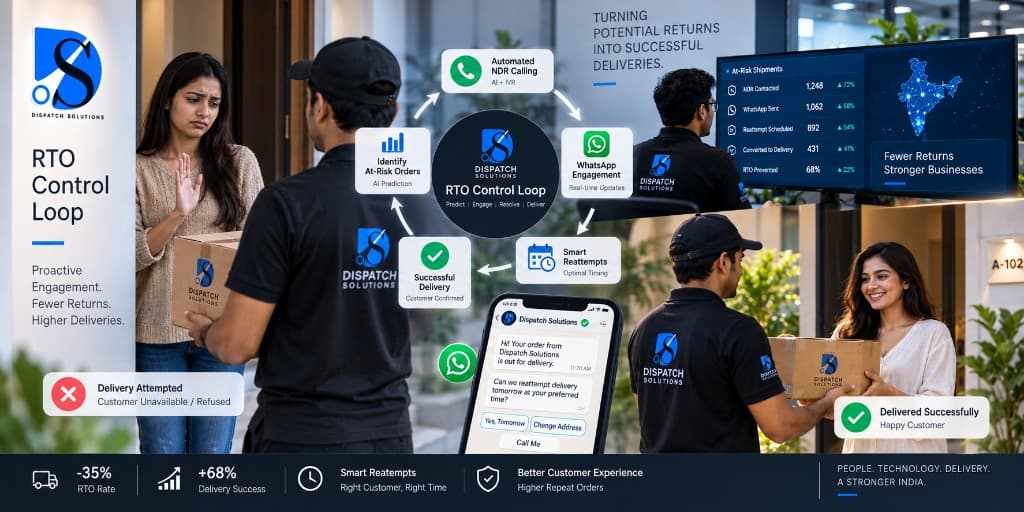
RTO — Return to Origin — is what happens when a shipment fails delivery and gets sent back to the seller instead of the buyer. For Indian D2C brands running high COD volumes, it's routinely one of the largest hidden costs on the P&L, precisely because it doesn't show up as a single obvious number.
The real cost stack
- Forward freight — already paid, and non-refundable, the moment the parcel shipped.
- Reverse freight — a second freight cost to bring the same parcel back.
- Warehouse handling — unboxing, quality-checking, and re-shelving a returned item.
- Inventory float — the SKU is unsellable while it's in transit back, which matters most during high-velocity sale periods.
- The lost sale itself — and, for a first-time buyer, quite possibly the lost customer too.
Add those up and a single RTO can cost several times the shipment's own freight charge — which is why even a modest reduction in RTO rate has an outsized effect on overall margin, more than most cost-cutting levers elsewhere in the operation.
Where RTO actually starts
RTO is rarely a delivery-day problem — it's usually decided earlier. The biggest drivers are COD orders placed without real intent to accept, addresses that were never going to be deliverable, and pincodes where a given carrier has chronically weak first-attempt performance.
The levers that actually reduce it
- Verify risky COD orders before dispatch — a WhatsApp confirmation catches a meaningful share of orders that were never going to convert.
- Route by carrier RTO history, not just by cost. The cheapest courier for a given pincode isn't always the cheapest shipment once RTO is priced in.
- Treat every NDR as a save opportunity, not a formality — most RTOs are NDRs that nobody intervened on in time.
- Watch pincode-level and buyer-level patterns. A small number of pincodes and repeat COD-refusers generate a disproportionate share of RTOs.
The takeaway
RTO isn't a fixed tax on doing business in India — it's a function of which carrier handled the shipment, whether anyone verified the order, and how fast someone acted on the first failed attempt. All three are controllable with the right routing and follow-up in place.
Ready to put this into practice?
Explore RTO mitigation tools